Cataract Surgery Melbourne
Cataract Surgery with Dr Simon Skalicky: Your Trusted Cataract Surgeon in Melbourne
Cataract surgery in Melbourne is a highly effective procedure that restores clarity and vibrancy of colours, which can be compromised by the development of cataracts. Cataracts cloud the eye's natural lens, interfering with the passage of light and affecting your ability to see clearly. Left untreated, cataracts may eventually lead to blindness. Choosing the right cataract surgeon is critical to achieving the best possible outcome for your eye health.
At Dr Simon Skalicky's clinic, you can trust Dr Simon Skalicky and his team to provide exceptional cataract surgery services in Melbourne. With a proven track record of delivering excellent results and patient satisfaction, Dr Simon Skalicky is the cataract surgeon you can rely on for your eye care needs.
Dr Simon Skalicky, a renowned specialist in cataract eye surgery, stands as a pillar of expertise and innovation in his field. His extensive medical training and dedication to the forefront of ophthalmological advancements equip him to adeptly handle the complexities of eye health. Leading a well-regarded clinic in Melbourne, Dr Simon Skalicky ensures the delivery of advanced treatments, state-of-the-art facilities, and a patient-focused approach. Dr Skalicky is known for his meticulous attention to detail, his kindness and genuine care for every patient, and the consistently excellent clinical results he achieves.
Recognised for his precision and care in cataract surgery, Dr Skalicky's profound understanding of ocular anatomy physiology and the latest surgical techniques guarantees a high standard of clinical excellence. His approach to patient care is holistic and personalised, ensuring a smooth journey through diagnosis, treatment, and post-operative recovery. Choosing Dr Skalicky not only ensures clinical excellence but also a compassionate and understanding patient experience, making a significant difference in the lives of those seeking renewed vision and improved quality of life.
What to Expect During Cataract Surgery
Pre-Operative Preparation: Prior to surgery, you will undergo detailed eye examinations to determine the specific intraocular lens (IOL) power needed for your vision correction. Dr Skalicky will discuss the different types of IOLs available and recommend the best option based on your lifestyle and vision needs.
During the Surgery: Cataract surgery typically lasts about 15 to 20 minutes and is performed under local anaesthesia, which numbs the area around your eye but keeps you awake. The procedure involves making a small incision in the eye to remove the cloudy lens and replace it with a clear artificial lens.
Post-Operative Care: After the surgery, you will rest in the recovery area for a few hours before you are allowed to go home. Dr Skalicky provides comprehensive post-operative care instructions, including eye drops to prevent infection and inflammation. You will need someone to drive you home following the procedure.
Recovery Timeline: Most patients notice an improvement in vision within a few days after surgery, but it may take 4 to 6 weeks to fully adjust to your new lenses. Regular follow-up visits are scheduled to monitor your recovery and ensure optimal results.
Why Choose Dr Simon Skalicky as Your Cataract Surgeon?
Dr Simon Skalicky and his team are committed to providing high-quality service that begins with open and unhurried consultations about cataracts, cataract surgery, and the potential outcomes. This personalised approach ensures you fully understand the process and have realistic expectations for your cataract surgery experience.
Premium pre-operative measurements are carried out to determine the correct power of the artificial lens required to restore your clear vision. Dr Simon Skalicky performs cataract surgery with the utmost care and diligence, adhering to the highest surgical review standards. As a result, his patients consistently enjoy excellent outcomes and an outstanding safety profile.
Determining if You Need Cataract Surgery
Cataracts can cause a reduction in the quality of vision, colour appreciation, distance and reading vision, and night vision. These changes can interfere with daily activities such as driving, watching TV, working on a computer, reading, and walking. After consulting with your optometrist or ophthalmologist, you can decide together if cataract surgery is necessary based on how much the cataracts interfere with your life.
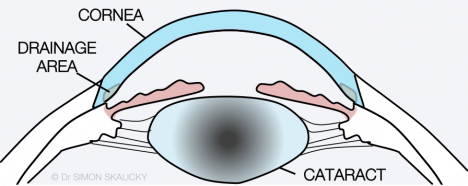
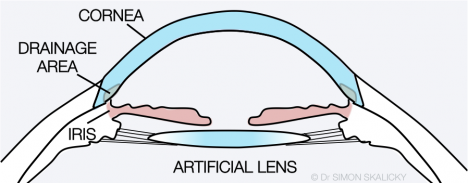
Cataract vs Cataract removal and artificial lens inserted
Two-panel diagram. Left panel: Cornea, Drainage area, Cataract. Right panel: Cornea, Drainage area, Artificial lens.
The Procedure
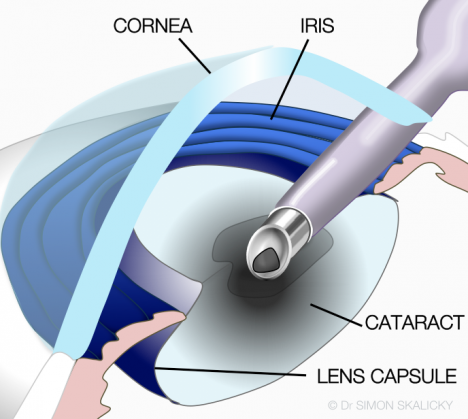
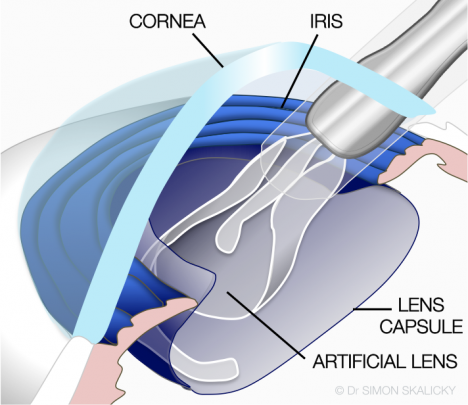
Dr Simon Skalicky uses a high-frequency ultrasound device to break up the cloudy lens into small fragments before gently suctioning them from the eye. This approach promotes rapid healing and minimises the risk of complications associated with cataract surgery. Once all remnants of the clouded lens have been removed, Dr Simon Skalicky will insert a clear intraocular lens (artificial lens) to replace your natural lens. The intraocular lens is secured in the same location where your natural lens had been.
Cataract surgery does not require an overnight stay in a hospital. It is a day procedure that typically lasts 15-20 minutes. You will be awake during the surgery, and you should be able to return home that afternoon or evening.
Preparing For Cataract Surgery
Before undergoing cataract surgery, it is essential to use lubricants the eyes to minimise post-operative dry eye syndrome symptoms. You will receive preservative-free lubricants to use four times daily for 2 weeks prior to the surgery.
On the day of the procedure, you will arrive at the operating theatre having fasted for several hours. The nursing staff will greet you and begin administering drops to dilate your pupil. You will also meet your anaesthetist, who will travel an IV cannula and arrange comfortable anaesthesia.
Removal of cataract and insertion of artificial lens
Two-panel diagram. Left panel: Cornea, Iris, Cataract, Lens Capsule. Right panel: Cornea, Iris, Lens Capsule, Artificial Lens.
Intraocular lens (IOL) options
Choosing the right intraocular lens for your eye
Every cataract surgery involves removing the eye's clouded natural lens and replacing it with an artificial intraocular lens, or IOL. The lens you choose has more influence on your post-operative vision than any other part of the procedure. There is no single best lens — the right choice depends on your prescription, your lifestyle, the health of the rest of your eye, and how dependent you'd like to be on glasses after surgery.
Dr Skalicky discusses lens options during your consultation and recommends the lens (or combination, if both eyes are being treated) that fits your visual goals and clinical profile. There are three main lens categories used in Australian cataract surgery — monofocal, multifocal, and extended depth of focus — and each is available with toric correction if you have astigmatism.
Monofocal IOL — the standard lens
Monofocal lenses provide clear vision at one fixed distance — most commonly distance vision, so you can drive, watch television, and recognise faces without glasses. Reading glasses are usually required for close work. Monofocal lenses offer the most predictable visual outcome and suit patients who are comfortable wearing reading glasses, or who have other eye conditions that may limit the benefit of premium lenses.
Multifocal IOL — reducing glasses dependence
Multifocal lenses are designed with multiple focal points — typically distance and near, or distance, intermediate, and near. They allow many patients to see across a range of distances without glasses. The trade-off is that some patients notice halos or glare around lights at night, particularly in the first few months after surgery. These visual side effects often diminish over time as the brain adapts, but they don't suit every patient or every prescription. Multifocal lenses are best suited to patients with healthy eyes (no significant macular, corneal, or optic nerve disease), realistic expectations about night-time vision, and a strong preference for being glasses-free for most daily tasks.
Extended depth of focus (EDOF) IOL
EDOF lenses are a newer category that creates an elongated, continuous range of focus rather than separate distance and near focal points. They typically provide good distance and intermediate vision (computer, dashboard, kitchen bench) with less night-time glare than multifocal lenses, though most EDOF wearers still use glasses for fine print and prolonged reading. They suit patients who spend significant time at intermediate distances and who want fewer night-time visual side effects than a full multifocal would create.
Toric correction — for patients with astigmatism
Astigmatism is an irregular curvature of the cornea that causes blurred vision at all distances. A lens without toric correction will not fully correct it — you'd still need glasses for distance even after surgery. Toric versions of monofocal, multifocal, and EDOF lenses are shaped to neutralise corneal astigmatism in addition to replacing the cataractous lens. If you have measurable astigmatism (typically more than 1 dioptre), Dr Skalicky will recommend the toric version of whichever lens category suits you.

How Dr Skalicky helps you choose
The lens-selection conversation happens at your consultation, after a full set of biometry measurements. Dr Skalicky reviews your corneal curvature, axial eye length, pupil size, and the health of your retina and optic nerve, then discusses how each suitable lens option is likely to perform for your visual goals. If you have other eye conditions — macular disease, glaucoma, dry eye, or significant corneal irregularity — these affect which lenses are appropriate, and that's part of the conversation.
There is no rush to decide before your consultation. Most patients find it helpful to think through how they use their vision day to day — driving at night, computer work, reading, sports, hobbies — and bring those preferences into the discussion.
Cost, Medicare and private health
Cataract surgery cost in Melbourne — what to expect
The total cost of cataract surgery depends on whether you have private hospital cover, the surgical facility used, and — for uninsured patients — the type of intraocular lens chosen. Rather than quoting generic figures, Dr Skalicky's rooms provide every patient with a written estimate of out-of-pocket costs after the initial consultation, so you know exactly where you stand before committing to surgery.
Medicare
Cataract surgery is listed under the Medicare Benefits Schedule (MBS) — the most common item number is 42702, covering lens extraction and intraocular lens insertion. Medicare contributes a rebate towards the surgeon's fee when the procedure is performed in hospital. Like most ophthalmic surgeons, Dr Skalicky's fee is above the MBS schedule fee, and the difference — known as the gap — is set out clearly in your written estimate.
Private health insurance
If you have private hospital cover that includes ophthalmology, your fund contributes towards the surgeon's and anaesthetist's fees and covers the hospital or day-surgery facility fee (a policy excess may apply). The exact contribution varies between funds and policies, so it's worth confirming your level of cover with your fund — your written estimate gives you the figures to do this.
Without private hospital cover, you can still have cataract surgery — either as a public patient through a hospital waiting list, or as a self-funded private patient. As a self-funded patient, you'll also cover the hospital facility fee and the cost of the intraocular lens; both are included in your written estimate.
The intraocular lens — how cover works
For patients with private hospital cover, the intraocular lens is covered by your health fund as part of the procedure — whether monofocal, multifocal, or EDOF, with or without toric correction. Your choice of lens does not change your out-of-pocket cost.
For uninsured (self-funded) patients, the lens is a direct cost, and premium lenses — multifocal, EDOF, and toric designs — cost more than a standard monofocal. The exact amount depends on the specific lens recommended for your eye and is confirmed in your written estimate.
Getting a personalised cost estimate
Because every patient's situation differs — your health fund and policy, whether one or both eyes are being treated, the lens recommended, and the surgical facility used — Dr Skalicky's rooms provide a written estimate covering the surgeon's fee, anaesthetist's fee, hospital facility fee, and (for self-funded patients) the lens. You can take this estimate to your private health fund to confirm exactly what your policy covers.
Risks, side effects and when to seek help
Cataract surgery is one of the most commonly performed and reliably successful surgical procedures worldwide, with serious complications occurring in a small minority of cases. Understanding what's normal during recovery and what isn't helps you know when to contact the clinic.
Common, expected side effects
In the first one to two weeks after surgery, most patients experience some combination of mild grittiness or a foreign-body sensation, light sensitivity, watery eyes, and fluctuating vision as the eye settles. These are normal and resolve as the eye heals. The post-operative drop regimen is designed to support this healing process.
Less common complications
Less common complications include posterior capsule opacification (a clouding of the lens capsule behind the new IOL — easily treated with a brief laser procedure called YAG capsulotomy, often months or years after the original surgery), persistent inflammation, raised eye pressure, refractive surprise (the final prescription differing from the planned outcome), and macular oedema. Most of these are manageable with appropriate treatment if detected promptly.
Rare serious complications
Rare but serious complications include endophthalmitis (an infection inside the eye), retinal detachment, and intraoperative complications such as posterior capsule rupture. These are uncommon — endophthalmitis occurs in approximately 1 in 1,000 cases or fewer. Modern surgical technique and the sterile theatre environment minimise these risks substantially.
When to contact the clinic
Contact Dr Skalicky's rooms — or attend the nearest emergency department after hours — if you experience any of the following in the days or weeks after your surgery: sudden decrease in vision, severe pain not controlled by simple pain relief, increasing redness, increasing light sensitivity, sudden onset of flashes or floaters, or any discharge from the eye.
Routine post-operative reviews are scheduled at day 1, week 1, and week 4. These reviews give Dr Skalicky the opportunity to detect any developing complications early, and they are an important part of the surgical service — not optional appointments.
Cataract Surgery Recovery
You will be discharged from surgery several hours after the procedure, but will need to have a family member or friend drive you home. A protective shield is placed over the eye to ensure its safety during the early stages of cataract surgery recovery.
Your first post-operative appointment will be scheduled for the following day with Dr Simon Skalicky. During this visit, the eye dressing will be removed, and your first eye drops will be administered. Dr Simon Skalicky will provide you with a strict eye care routine to follow throughout your recovery process. You will be required to use prescription eye drops four times a day — chloramphenicol (an antibiotic) for 10 days and prednisolone forte (an anti-inflammatory agent) for two weeks.
Four weeks post surgery, you will have a final review appointment with Dr Simon Skalicky. Once your eyes have fully recovered, you can get updated spectacles from your optometrist. It is crucial to wait until the eyes have completely healed before obtaining new glasses.
BEFORE / AFTER "T" eye-chart image.

What are the benefits of cataract surgery?
Cataract surgery offers numerous benefits, including improved vision quality, enhanced colour perception, and reduced dependency on glasses for reading and distance vision. With Dr Simon Skalicky as your cataract surgeon, you can expect excellent results that may enable you to be spectacle-free for distance vision.
In patients with glaucoma, raised eye pressure, or narrow angles, cataract surgery can widen the drainage angle, improving fluid drainage from the eye and lowering eye pressure. Additionally, minimally invasive glaucoma devices (e.g. the iStent) can be inserted during cataract surgery to better control eye pressure and reduce the need for long-term glaucoma eye drops.
Why Trust Dr Simon Skalicky as Your Cataract Surgeon
Cataract surgery is a life-changing procedure that can significantly improve your quality of life by restoring clear vision and vibrant colours. If you or a loved one is experiencing vision issues due to cataracts, it's crucial to choose a skilled and experienced cataract surgeon like Dr Simon Skalicky.
Dr Simon Skalicky's expertise as a cataract surgeon is backed by years of experience, dedication to patient care, and adherence to the highest standards of surgical practice. His comprehensive approach to cataract surgery ensures that every aspect of your care, from the initial consultation to post-operative follow-up appointments, is tailored to your individual needs. This patient-centric approach guarantees that you receive personalised attention and support throughout the entire process.
To learn more about cataract surgery and whether it is the right procedure for you, contact the clinic to schedule a consultation. Don't let cataracts compromise your vision and quality of life any longer. Book in a consultation with Dr Simon Skalicky, your trusted cataract surgeon in Melbourne, and take the first step towards clearer vision and a brighter future.

FAQs (Frequently Asked Questions)
What is cataract surgery and how does it work?
Cataract surgery involves removing the eye’s cloudy natural lens and replacing it with a clear artificial lens (intraocular lens or IOL). The procedure is typically performed under local anaesthesia and restores clarity of vision.
Who is a good candidate for cataract surgery in Melbourne?
Anyone experiencing significant vision changes due to cataracts — such as blurred vision, faded colours or difficulty driving at night — may be a candidate. After examination, Dr Skalicky will advise whether surgery is necessary based on your visual needs and eye health.
How long does cataract surgery take?
Modern cataract surgery generally takes about 15–20 minutes as a day procedure. You remain awake under local anaesthesia and can return home the same day with post-operative care instructions.
What should I expect during recovery after cataract surgery?
Most patients notice improved vision within a few days, though full visual adjustment can take 4–6 weeks. You will use prescribed eye drops to prevent infection and inflammation and have follow-up visits with your surgeon.
Are there any risks with cataract surgery?
Cataract surgery is one of the most common and successful surgical procedures, but as with all surgery, it carries small risks. A thorough consultation will cover possible complications and how they are managed.
What types of intraocular lenses (IOLs) are available?
Different IOLs are available to suit your vision goals, including monofocal lenses for distance or near vision and premium options that reduce dependency on glasses. Dr Skalicky will discuss the best lens choice for your lifestyle.
Will I need someone to accompany me to cataract surgery?
Yes. Since you’ll receive local anaesthesia and won’t be able to drive immediately after the procedure, it’s recommended to have a friend or family member bring you to and from your surgery.
How soon can I drive or fly after cataract surgery?
Most patients can drive once they feel comfortable and vision is stable, often within days. Flying is typically safe after routine recovery, but follow-up appointments with your surgeon should confirm readiness.
How much does cataract surgery cost in Melbourne?
It depends on whether you have private hospital cover and which surgical facility is used. With private hospital cover, your fund covers the facility fee and the intraocular lens (regardless of lens type), and contributes towards the surgeon's and anaesthetist's fees — the remaining gap is set out in a written estimate provided after your consultation. Without insurance, you also cover the facility fee and the lens, with premium lenses costing more than a standard monofocal. Every patient receives a written estimate before committing to surgery.
Is cataract surgery covered by Medicare?
Yes. Cataract surgery is listed under MBS item 42702 (lens extraction and IOL insertion), and Medicare contributes a rebate towards the surgeon's fee when the procedure is performed in hospital. Most ophthalmic surgeons charge above the schedule fee, and the difference — the gap — is detailed in your written estimate. Hospital facility fees are covered by private hospital insurance with ophthalmology cover.
What's the difference between laser and traditional cataract surgery?
Traditional cataract surgery uses an ultrasound device (phacoemulsification) to break up the cataract before removal. Laser-assisted cataract surgery uses a femtosecond laser to perform some of the initial steps — making the corneal incision, opening the lens capsule, and partially fragmenting the cataract — before the surgeon completes the procedure. Dr Skalicky discusses which approach is appropriate for your eye at your consultation.
Can cataracts be treated without surgery?
No. There are no eye drops, supplements, or non-surgical treatments that can remove or reverse a cataract. Stronger glasses or better lighting may help compensate for early cataract changes, but surgery is the only effective treatment when a cataract begins to affect your daily life. Delaying surgery beyond the point where vision is significantly impaired does not improve outcomes.
Can both eyes have surgery on the same day?
In most cases, cataract surgery is performed on one eye at a time, with the second eye treated one to four weeks after the first. This allows the first eye to settle and lets Dr Skalicky fine-tune the lens calculation for the second eye based on the outcome of the first. Same-day bilateral surgery is sometimes considered in specific circumstances — Dr Skalicky discusses this option where appropriate.
Accreditations & Credentials
Dr Skalicky is an active clinician, surgeon, researcher, teacher, academic and health advocate who has published over 70 articles in international ophthalmology journals, combining a busy surgical practice with an ongoing contribution to ophthalmic research and education.